Permits, contracts, taxes - the arrival kit
Working in Switzerland: the practical guide
Switzerland recruits internationally, and the paperwork rewards preparation. The median full-time salary was CHF 7,024 gross per month in 2024 per BFS - but between the permit you hold, the trial clause in your contract and the withholding tax on your first payslip, the number that matters takes a few steps to reach. This guide walks the sequence internationals actually hit: permit, contract, deductions, tax.
By the SwissPay editorial team · Updated $1
Key numbers at a glance
| Rule | Figure | Source |
|---|---|---|
| Median gross salary, full-time, 2024 | CHF 7,024 / month | per BFS |
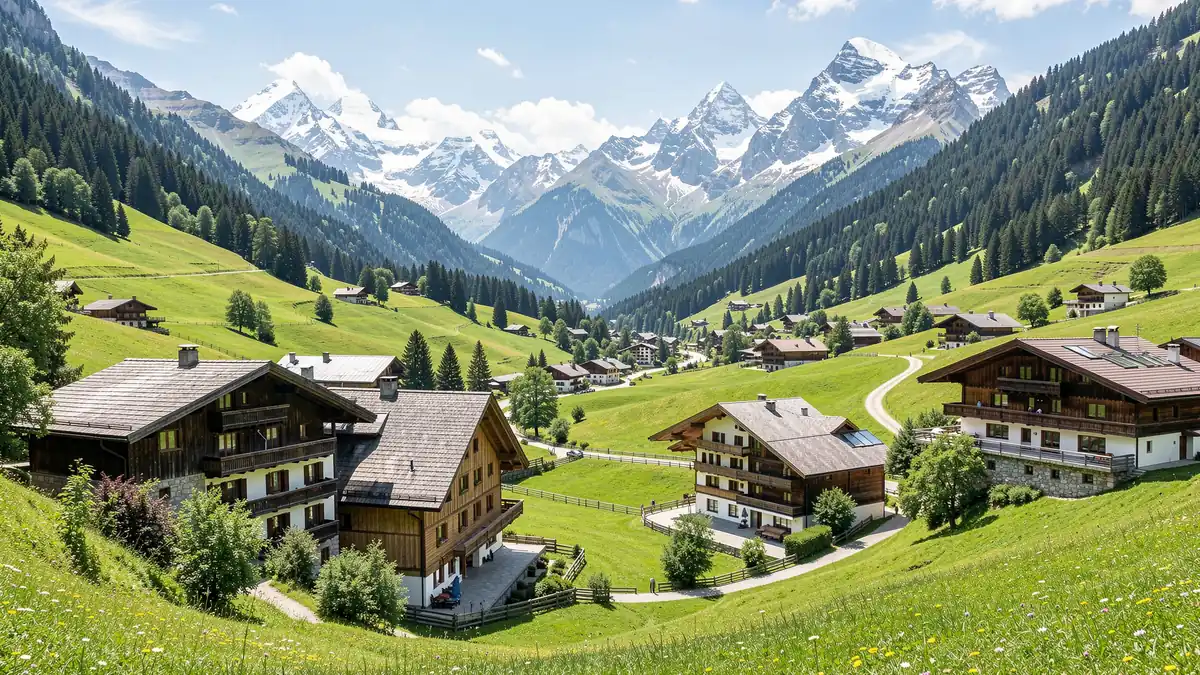
What to know before working in Switzerland
Start with the pay landscape so you can sanity-check any offer. Per the BFS Swiss Earnings Structure Survey 2024, half of all full-time employees earned more than CHF 7,024 gross per month (about CHF 84,300 a year), the lowest-earning 10% stayed under CHF 4,635 and the best-paid 10% cleared CHF 12,526. Education moves the median sharply: university graduates median CHF 10,533 per month, university-of-applied-sciences graduates CHF 9,288 and holders of a federal VET diploma (CFC/AFC) CHF 6,390, per BFS 2024. Branch matters as much as diploma - banking paid a branch median of CHF 10,723 per month and pharma CHF 10,159, while hospitality ran at CHF 4,715-4,744 and personal services CHF 4,496. Region sets the frame on top: the Zurich region medians CHF 7,502 and Ticino CHF 5,708, per BFS.
Then budget for the costs that are not on the payslip. Mandatory health insurance (KVG) is contracted privately, not withheld: the average adult premium is CHF 465.30 per month in 2026 per the Federal Office of Public Health (BAG). Rents in Zurich, Zug and the Lake Geneva rim typically run far above those in peripheral cantons - check current listings rather than averages. And the standard of living assumes the full deduction stack: 5.3% AHV/IV/EO, 1.1% ALV, roughly 1% accident insurance and the age-based BVG pension share, then income tax of roughly 7.5-18.5% effective depending on canton. On the median salary that leaves a single person near 70-75% of gross; the exact figure comes from the Swiss salary calculator, and the canton choice is analysed in our salary by canton comparison.
| Benchmark (gross, full-time) | CHF / month | Source |
|---|---|---|
| Median, all Switzerland | 7,024 | per BFS, 2024 |
| Median, university graduates | 10,533 | per BFS, 2024 |
| Median, federal VET diploma (CFC) | 6,390 | per BFS, 2024 |
| Median, banking / pharma branches | 10,723 / 10,159 | per BFS, 2024 |
| Median, Zurich region / Ticino | 7,502 / 5,708 | per BFS, 2024 |
One statistic deserves the attention of every arriving professional: the 13th salary. Per BFS 2024, 75.9% of employees received one, and on top of that 32.6% received an annual bonus averaging CHF 11,967. Always ask whether a quoted figure includes the 13th payment - a "CHF 8,000 per month" offer can mean CHF 96,000 or CHF 104,000 a year.
Permits, contracts and the trial period
The permit decides your tax procedure, your mobility and your family options. EU/EFTA nationals benefit from the Free Movement of Persons Agreement: after registering with the commune you receive a B residence permit that doubles as work authorisation, valid five years for contracts of 12 months or more. Third-country nationals face annual quotas and a labour-market test; their B permit typically renews yearly, and the C settlement permit - unlimited and close to permanent residency - normally follows after 10 years of residence, or 5 for EU/EFTA, US and Canadian nationals and certain others, per the State Secretariat for Migration (SEM). The short-term L permit covers stays up to a year, extendable to two; the G permit is for cross-border commuters living abroad.
| Permit | Who / validity | Payroll consequence |
|---|---|---|
| L - short-term | stays up to 1 year, extendable to 2 | withholding tax (Quellensteuer) |
| B - residence | EU/EFTA: 5 years; third country: 1 year, renewed annually | withholding tax until C or ordinary assessment |
| C - settlement | unlimited; after 10 years (5 for EU/EFTA, US, Canadian and certain nationals) | ordinary tax return |
| G - cross-border | live abroad, work in CH; weekly return duty | withholding tax in the work canton |
Salary differences by permit status are real but run through role mix. Per BFS 2024, in high-responsibility positions foreign employees on a B permit earned a median of CHF 13,090 gross per month, C-permit holders CHF 11,966 and G cross-border commuters CHF 11,207, against CHF 10,989 for Swiss staff. In positions without management functions the order flips: CHF 5,421 for B-permit holders, CHF 6,034 for C and CHF 5,950 for G, versus CHF 6,765 for Swiss employees. International arrivals cluster at both ends of that table - which end depends on the contract you negotiate.
That contract follows the Code of Obligations, and three clauses decide most disputes. The trial period: one month by law, extendable by written agreement to a maximum of three months, with seven days notice for either side during the trial, per Article 335b. Notice periods after the trial: one month in the first year of service, two months from the second to the ninth year, three months thereafter, ending on a payment period, per Article 335c. Vacation: a minimum of four weeks per year, five weeks for employees under 20, per Article 329a - with cantonal public holidays on top. Written contracts are standard practice, and collective agreements (GAV) in sectors like nursing, construction and hospitality override individual terms, so check whether one covers your job before you sign.
| Contract rule (Code of Obligations) | Minimum / maximum |
|---|---|
| Trial period | 1 month default, max 3 months by written agreement |
| Notice during trial | 7 days |
| Notice after trial, first year | 1 month |
| Notice, years 2-9 / thereafter | 2 months / 3 months |
| Paid vacation | 4 weeks (5 weeks under age 20) |
| 13th salary | not mandatory - received by 75.9% per BFS 2024 |
Tax comes last but bites monthly. B- and L-permit holders and G commuters normally pay Quellensteuer - withholding tax deducted by the employer using cantonal tables that approximate the ordinary rates (roughly 7.5-18.5% effective for a single on a mid-level salary). You switch to ordinary assessment with a tax return when you obtain a C permit, marry a Swiss or settle-status resident, or pass the cantonal income threshold for obligatory ordinary taxation - verify your situation with the Federal Tax Administration (ESTV) or your cantonal tax office. For what arrives after tax, the profession deep-dives on nurse salary and software engineer salary cover the two classic entry routes, and the SwissPay hub holds the national benchmarks per BFS.
FAQ
Do EU citizens need a work permit for Switzerland?
Yes, a residence permit - but under the Free Movement of Persons Agreement the EU/EFTA permit doubles as the work authorisation. After arrival you register with the commune and receive a B permit valid five years for a job of 12 months or more. Third-country nationals face annual quotas and a labour-market test; their B permit is usually issued for one year and renewed annually, and the C settlement permit normally requires 10 years of residence (5 for US and Canadian nationals and certain others).
How long is the trial period in Switzerland?
The statutory default is one month, and by written agreement it can be extended to a maximum of three months - anything longer is automatically cut to three months, per Article 335b of the Code of Obligations. During the trial either side can terminate with seven days notice. Fixed-term contracts have no trial period unless one is agreed in writing.
Is the 13th salary mandatory in Switzerland?
No, it is a contractual or collective-agreement benefit - but it is very common: per the BFS Swiss Earnings Structure Survey 2024, 75.9% of employees received a 13th salary, and 27.9% of firms pay none at all. A CHF 100,000 offer with a 13th salary is worth about CHF 7,700 more per year than the same base without it, so always compare annual totals, not monthly base.
What is the minimum paid vacation in Switzerland?
Four weeks per year for employees aged 20 and over, and five weeks for those under 20, per Article 329a of the Code of Obligations. Many collective agreements grant five weeks for all staff, and public-sector cantonal scales often exceed the minimum. Public holidays are set by canton and are paid on top.
What is Quellensteuer - Swiss withholding tax?
Foreign employees on a B or L permit, plus cross-border G commuters, usually have income tax withheld directly from their salary each month (Quellensteuer). The withholding rates approximate the ordinary federal, cantonal and communal rates - roughly 7.5% to 18.5% effective for a single on a mid salary, depending on canton. Once you hold a C permit, marry a Swiss citizen or reach a taxable income above the cantonal threshold, you file a regular tax return instead.
Do foreign workers earn less than Swiss employees?
It depends on seniority, not nationality as such. Per BFS 2024, in high-responsibility positions foreign staff on a B permit earned a median of CHF 13,090 gross per month against CHF 10,989 for Swiss employees, while in positions without management functions the pattern flips: CHF 5,421 for B-permit holders versus CHF 6,765 for Swiss staff. Role mix, qualification and seniority drive the difference - public pay scales apply identical bands regardless of nationality.